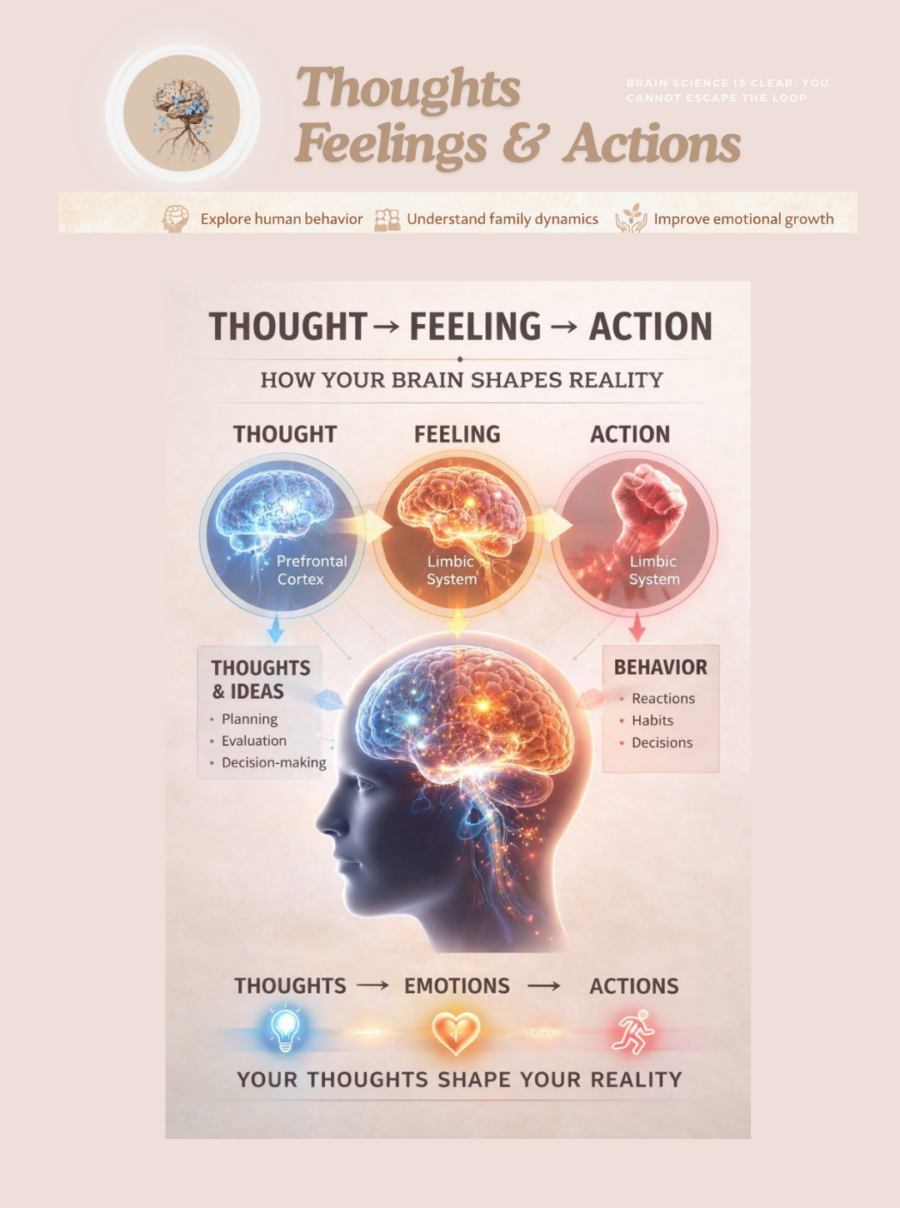
Character is not what you say. Character is what you do. And what you do is the final output of a process that begins in your brain: thought, emotion, action. Understanding this process is not just philosophy—it’s neuroscience.
Every thought triggers a cascade of neural activity. In the prefrontal cortex, your brain evaluates possibilities, plans actions, and assigns value. Simultaneously, the limbic system processes the emotional charge of that thought. Emotions are not incidental—they are the fuel for behavior. Fear, desire, joy, or frustration mobilize your body for action. Once thought and feeling align, the brain activates motor pathways, translating intention into behavior. In short: thought becomes feeling, feeling becomes action, action becomes reality.
This process explains why the environment often mirrors the mind. Research in environmental psychology shows strong correlations between mental habits and physical surroundings. Cluttered, disorganized, or neglected spaces are associated with stress, reduced executive function, and impaired self-regulation. While it is theoretically possible to maintain a chaotic environment while thinking clearly, most people who appear “mentally organized but physically disordered” are in fact unaware of the disconnect between intention and behavior. Your external world is a mirror for your internal processes more often than you think.
The implications extend beyond housekeeping. In society, we increasingly prioritize feelings over facts. Neuroscience teaches us that feelings are real—they shape motivation—but they are not a substitute for reality. You may feel entitled to a truth, identity, or outcome, but the external world operates independently of your internal narrative. Reality checks—feedback from facts, from the environment, from other people—are essential. Without them, thoughts remain untested, actions become inconsistent, and character cannot solidify.
Accountability is the mechanism that ensures alignment. Surrounding yourself with people willing to challenge your assumptions, confront your beliefs, and demand evidence of your actions is crucial. Cognitive-behavioral research confirms that feedback loops—where thought, emotion, and action are observed and corrected—strengthen self-regulation and ethical behavior. Character is not a private belief; it is the repeated verification that your inner life produces measurable, responsible outcomes in the world.
Parenting, leadership, and personal growth are daily exercises in this reality-check principle. Every choice is a test of whether your thoughts and emotions are translating into effective action. Every action has consequences that cannot be wished away. Character is forged in this tension between internal belief and external verification, between feeling and fact, between desire and discipline.
In the end, the brain science is clear: you cannot escape the loop. Thoughts drive feelings; feelings drive actions; actions shape reality. Ignore this process at your peril. Build awareness, demand accountability, and align your internal narrative with your external life. That is your ultimate reality check.