To all the new moms and dads out there: understanding your child’s executive function (EF) in the brain is the single best way to raise a resilient child.
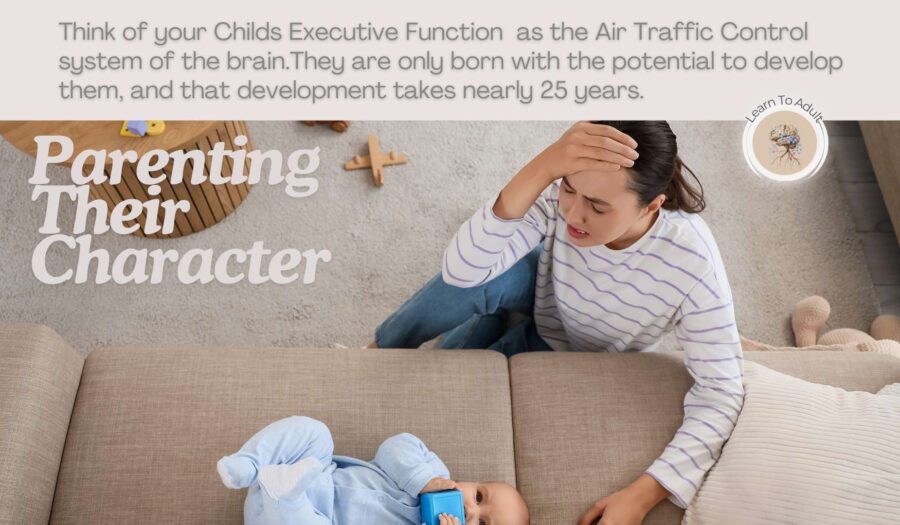
Think of your child’s executive function as the Air Traffic Control system of the brain. It manages incoming information, filters distractions, and stops impulses. But here is the catch: babies are born without these skills. They are only born with the potential to develop them, and that development takes nearly 25 years.
The “CEO” is a Work in Progress
Your child’s executive function is not a single switch; it is a complex “tag team” of skills including working memory, mental flexibility, and self-control. When your toddler has a meltdown because you cut their toast into triangles instead of squares, it isn’t “bad behavior.” It is a hardware limitation. Their Prefrontal Cortex (the CEO) simply hasn’t built the wiring yet to handle that level of emotional “re-routing.”
How Your Child’s Executive Function Develops (The “Scaffolding” Phase)
EF develops through co-regulation. As a parent, you are the “External Prefrontal Cortex” for your child.
-
Ages 0–3: Development is all about focus and basic impulse control. You help them develop EF every time you play “Peek-a-boo” (working memory) or “Red Light, Green Light” (inhibitory control).
-
Ages 3–5: This is the “Invention” phase. They start to understand rules and can hold a few instructions in their head, but they still tire easily.
-
The Golden Rule: EF is like a muscle. It grows when it is exercised in a safe environment, but it “atrophies” or shuts down when the child feels threatened or stressed.
How It Does NOT Develop
It is vital to understand that your child’s executive function cannot be shamed or punished into existence. Stress is the Enemy: When a child is under high stress (yelling, harsh punishment), the brain enters “Survival Mode.” The Prefrontal Cortex shuts down, and the Amygdala (the “alarm”) takes over. You cannot teach a child to plan or regulate while their brain is in a state of high alarm. It isn’t “Common Sense”: You cannot assume a child will “just know” how to clean a room. To a child with developing EF, “Clean your room” is a massive, overwhelming project. Without your help to sequence the steps, they will likely just sit on the floor and play, not because they are defiant, but because they are cognitively lost.
How to Be a Constructive Part of the Team
To be a constructive parent in this area, you must move from being a Judge to being a Coach.
-
Lower the Cognitive Load: Instead of “Clean your room,” say, “First, put all the blue cars in the box.” Give the brain one file to process at a time.
-
Narrate the Process: Talk out loud about your own EF. “I’m feeling frustrated because I lost my keys. I’m going to take a breath and think about where I saw them last.” You are literally modeling the “CEO” behavior they haven’t built yet.
-
Validate the “Engine” Overheat: When they melt down, recognize that their “Internal CEO” has just gone offline. They don’t need a lecture; they need you to be their “External Brakes” until their system cools down.
The Bottom Line: Your child isn’t giving you a hard time; they are having a hard time because their brain’s air traffic control tower is still under construction.