There is something about our modern conversation around relationships that increasingly concerns me.
We speak a great deal about boundaries, independence, protecting our peace, cutting ties and removing “toxic” people from our lives. Sometimes those things are absolutely necessary.
But somewhere in that conversation, I wonder whether we have started confusing differentiation with disconnection.
A person’s early relationships influence how they experience loyalty, rejection, conflict and attachment in later relationships. We don’t enter adulthood, marriage or parenthood as blank pages. We carry our histories with us.
And healthy adulthood should surely mean learning to integrate those relationships—not automatically replacing one with another.
Why should loving your spouse require diminishing your parents?
Why should becoming a parent require rejecting the family from which you came?
Why should loyalty to one person require proving that loyalty by withdrawing it from somebody else?
Healthy relationships should be able to coexist.
Marriage naturally changes priorities. A couple needs its own boundaries, identity and decision-making space. A new family unit must be allowed to develop. But differentiation is not the same as fragmentation.
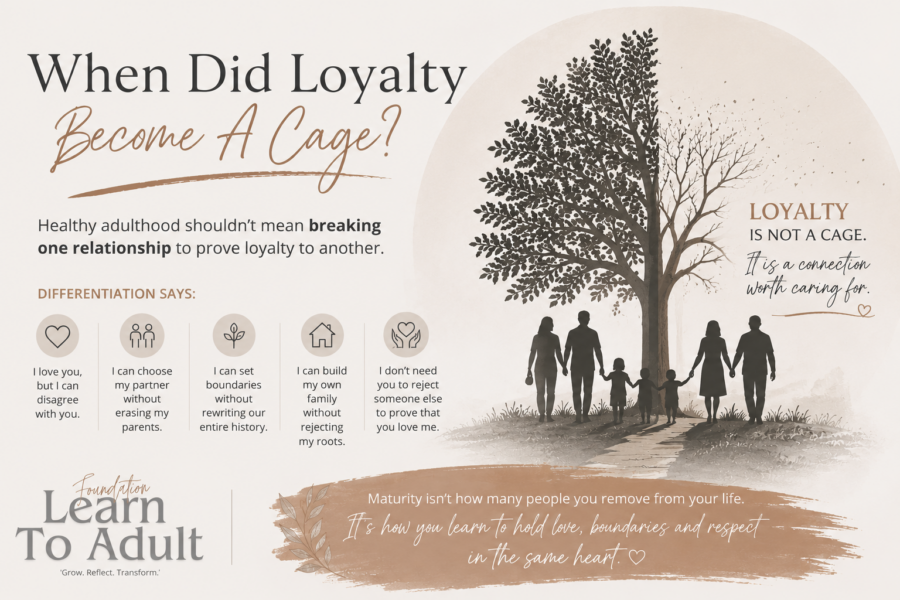
Differentiation says:
“I love you, but I can disagree with you.”
“I can choose my partner without erasing my parents.”
“I can establish boundaries without rewriting our entire history.”
“I can belong to my new family without pretending that my old relationships no longer matter.”
“I don’t need you to reject someone else to prove that you love me.”
That, to me, is emotional maturity.
Fragmentation is different.
Fragmentation tells us that relationships have to compete. That loyalty is scarce. That if one person becomes more important, somebody else must become less important. That conflict means somebody has to be removed rather than relationships being renegotiated.
And perhaps that is something worth questioning.
Because human beings were never designed as isolated emotional islands. We exist within networks of attachment: parents, children, siblings, partners, grandparents, friends and communities.
Of course there are relationships involving abuse, coercion or genuine psychological harm where distance or complete separation may be necessary. Nobody should be expected to maintain a harmful relationship simply in the name of “family.”
But estrangement should not become our cultural shorthand for emotional growth.
Sometimes maturity isn’t about cutting the cord.
Sometimes it is about developing a strong enough sense of self that you don’t have to cut one relationship apart in order to build another one.
Maybe the goal shouldn’t be fewer attachments.
Maybe it should be healthier ones.