
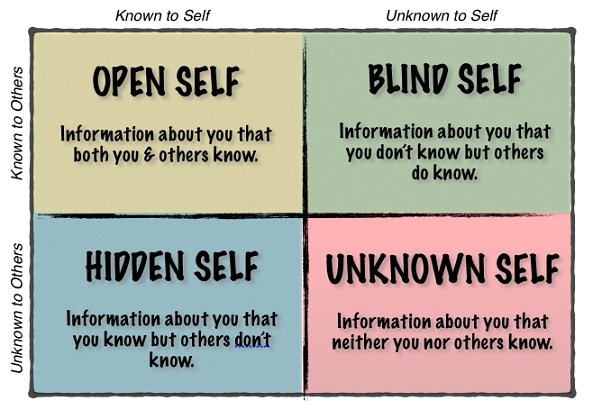
In 1955, psychologists Joseph Luft and Harry Ingham were researching group dynamics at the University of California. By studying how people in groups interacted with one another, the psychologists discovered that there was a disparity between how people thought others perceived them and how other people actually perceived them. They realized that the disparity was due to the fact that people do not know themselves well and find it difficult to accurately assess what components of their personality are known to others.
It is a strange phenomena that people in general put so much effort in creating a persona that reflects their level of success. Their houses, cars what they studied and most of all how well they have done for themselves. Most of these reflections come from a need of outer validation. The need to present themselves in the best possible way and to create at times also a false sense of wellbeing to people they are surrounded or interact with.
Everyone has a persona, whether they realize it or not, because constructing one is a natural part of psychological development. Ego development and persona construction go hand-in-hand.
Whenever you are with others, you are communicating. It’s true that most people think ‘communication’ is merely about talking. It’s not though; talking is just one element of what it means to communicate. Try thinking more widely about the concept of communication. In essence profiling is just another form of communication. Subliminal messaging. This in it self is not a problem, we all profile our worlds and ourselves to some extend, for good and bad reasons. At least we are fully aware of the unlimited power we to have some control over what we expose to people around us. In a noble way being transparent is important, giving people a clear understanding of who we are, what we value and to what level we will tolerate their behavior towards us. It is when we are using this power to create a false persona, especially when people seem to care more about their outer appearances creating an elevated false persona that as what they care about what is happening on the inside, that we have to question why the gap?
Both of the above has its place and certainly doesn’t point to abnormal behavior. In essence it is the gap between your self-perception and other people’s perception. The question has to be raised is this a voluntary action on our side or is it a predetermined action. The problems start to emerge when what you selling on the outside is not a true reflection of who you are on the inside. Why the need for two different personas? What are you hiding or haven’t you addressed. What do you need to hide or keep away from people in order not to distort the picture they have of you. Are you even aware of the fact that there is a huge gap? As a result of this gap between our self-perception and other people’s perception of us, we tend to interact with people based on one of the two identities.
Let’s start with the part that we can control. Self awareness.
“Self-awareness is the ability to focus on yourself and how your actions, thoughts, or emotions do or don’t align with your internal standards. If you’re highly self-aware, you can objectively evaluate yourself, manage your emotions, align your behavior with your values, and understand correctly how others perceive you.”
What is the effect of low self awareness? Have you ever dealt with someone who you felt was acting immaturely? You made the conclusion based on the things they said or did. The root problem could be a lack of awareness of self and how one is perceived by others.
Interestingly, a person could be highly intelligent and still not have a strong ability to self-introspect. Regardless of the root cause, low self-consciousness can result in the following problems:
In other words, you can’t fix what you don’t realize is broken. “What self-awareness does is allow you to see your natural [shortcomings] and how those might impact others around you. Without self-awareness, a person is likely to “overestimate their strengths and underestimate what stands in their way
As a result, a gap exists between our self-perception and other people’s perception of us, and it is a gap that we find difficult to identify.
The Johari Window can help diminish that gap. It is a self-awareness tool that helps us understand the differences between how people see us and how we see ourselves.The tool is based on the premise that our interactions with other people are based on these differing perceptions, and that when we have more aligned views with others, we will be able to have more effective and engaging interactions.
Focusing attention on your SELF helps you identify and change harmful behaviors to achieve positive outcomes. Moreover, objective self-awareness plays a key role in the development of self-conscious emotions, such as embarrassment, guilt, and shame.
How to Know Someone Lacks Self-Awareness
They’re unable to see how the current situation is linked to their actions. The disconnect often prevents them from taking responsibility for their role in conflicts. After flying off the handle with their partner, someone high in self-awareness can introspect by asking themselves, “Why did I behave in that manner?” They’ll use the answer to guide future reactions.
