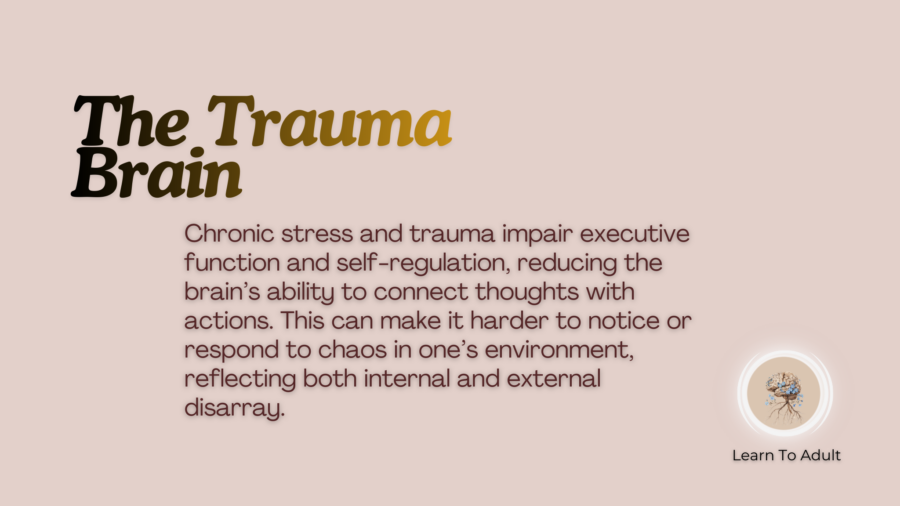
In a recent TikTok video, I explored the concept of the trauma brain and how our mental processes are directly reflected in our external environment. I explained how a chaotic or disorganized world can often indicate a highly stressed brain, with low activity in the frontal lobes and diminished self-regulation. This state creates a disconnect between thoughts and actions, making it difficult to respond effectively to challenges or maintain consistent, safe relationships. I also highlighted that when someone cannot notice or register the chaos around them, it often reflects a brain that is fighting a battle it hasn’t fully processed—limiting their ability to create stability and safety in their relationships.
While this discussion was informal, these observations are strongly supported by scientific research. Studies in neuroscience and psychology demonstrate that chronic stress impairs executive functions—such as working memory, attention, inhibition, and cognitive flexibility—that are essential for planning, organizing, and responding effectively to one’s environment. This explains why a stressed brain may struggle to notice or manage chaos in its surroundings (Girotti et al., 2017).
Executive functions are also closely tied to self-regulation, which allows us to control impulses, regulate emotions, and maintain goal-directed behaviour. When these processes are disrupted, our brain struggles to connect intentions with actions, leading to the disconnect between thought and behaviour I discussed in my video (Miyake & Friedman, 2012).
Research further shows that chronic stress is associated with weaker executive functioning and reduced self-control in everyday life. This supports the idea that a person may be contending with challenges they cannot fully perceive or act on because their cognitive resources are taxed, limiting their ability to create safe, stable relationships (McEwen & Morrison, 2020).
Finally, experimental studies on acute stress and executive performance indicate that stress hormones can directly impair prefrontal activity, reducing working memory and inhibitory control. This evidence reinforces the idea that stress not only affects how we think but also how we perceive and respond to our environment, making it harder to notice and respond to disarray around us (Shields, Sazma, & Yonelinas, 2016).
Taken together, these studies provide a scientific foundation for understanding how a stressed, low-activity brain with impaired self-regulation can lead to disconnection between perception, thought, and action, manifesting in both internal and external chaos. By understanding these mechanisms, we can better appreciate why trauma and stress shape not only our internal experiences but also the world we create around us.
References
Girotti, M., Adler, S. M., Bulin, S. E., Fucich, E. A., Paredes, D., & Morilak, D. A. (2017). Prefrontal cortex executive processes are affected by stress in health and disease. Progress in Neuropsychopharmacology & Biological Psychiatry, 82, 144–155. https://pmc.ncbi.nlm.nih.gov/articles/PMC5756532/
Miyake, A., & Friedman, N. P. (2012). Executive functions and self-regulation. Trends in Cognitive Sciences, 16(8), 426–434. https://www.sciencedirect.com/science/article/pii/S1364661312000289
McEwen, B. S., & Morrison, J. H. (2020). Chronic stress, executive functioning, and real-life self-control. Psychoneuroendocrinology, 113, 104550. https://pubmed.ncbi.nlm.nih.gov/32858777/
Shields, G. S., Sazma, M. A., & Yonelinas, A. P. (2016). The effects of acute stress on executive function: A review and integration. Frontiers in Psychology, 7, 461. https://www.frontiersin.org/journals/psychology/articles/10.3389/fpsyg.2016.00461/full